South Korea’s top scorer in this year’s tax accountant exam admitted on 15 November 2026 that he cheated with a miniature camera, a phone and an AI tool. Nobody in the exam room caught him. The government’s answer is telling: it now plans to look for cheating in the scores themselves, after the exam is over.
That second part is the bit worth your attention if you run exams of your own. Proctors missed this case for eight months. A results sheet might not have. Here’s what happened, what Korea plans to check from now on, and how to run the same checks on your own exam results before you release them.
What happened in the 2026 tax accountant exam
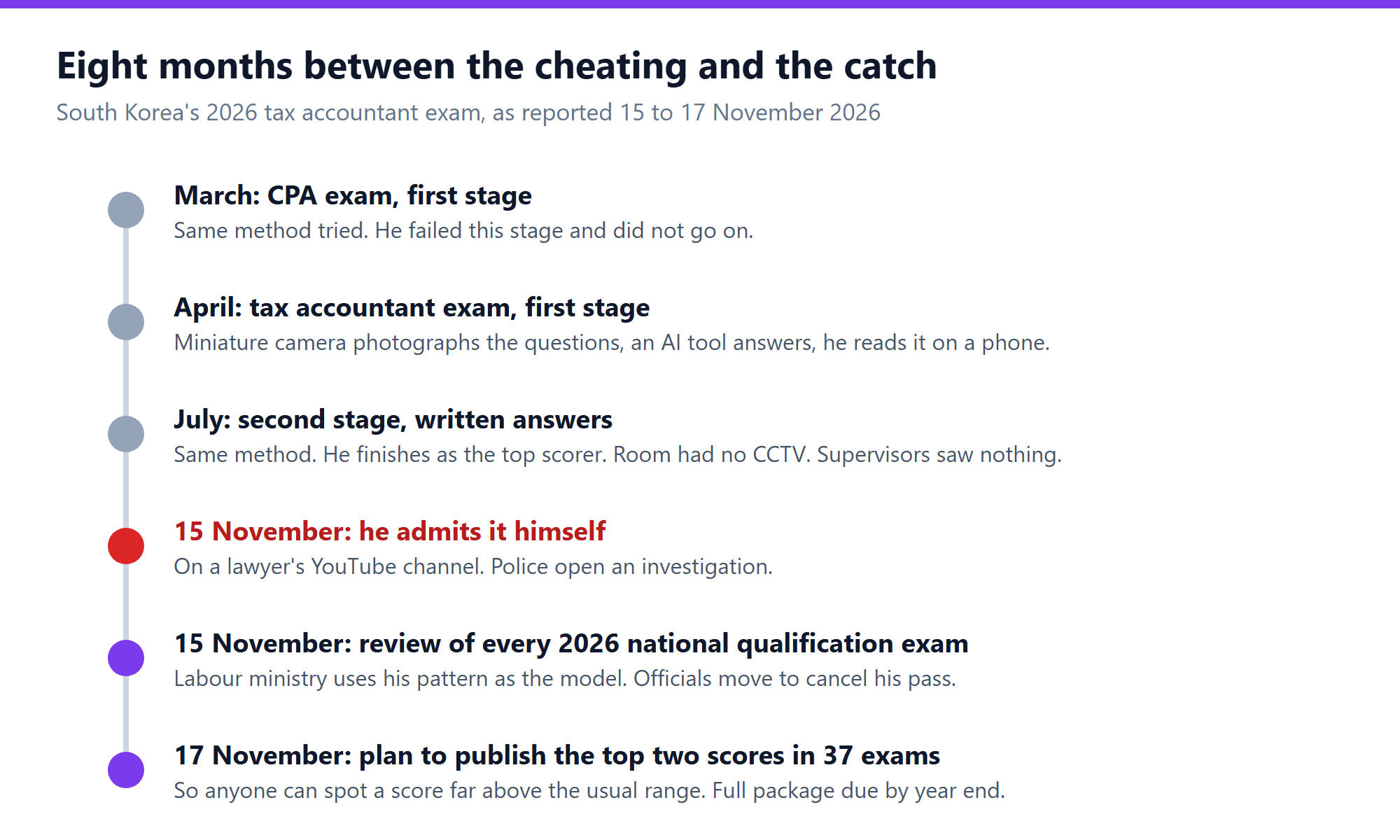
The candidate sat both stages of the 2026 tax accountant qualification, the first in April and the second, with written answers, in July. According to reports in the Korean press, he photographed the questions with a miniature camera, sent them to a generative AI tool and read the answers on a smartphone. He finished as the top scorer.
He’d tried the same method in March on the first stage of the certified public accountant exam. That time he failed and didn’t go on to the second stage.
The case didn’t come to light through the exam supervisors. He admitted it himself on 15 November, in a video on a lawyer’s YouTube channel, after other candidates had already raised questions about his unusually high marks. Police have opened an investigation. The Ministry of Employment and Labor says the tax accountant exam was held in a borrowed school classroom with no CCTV inside.
Korea’s response: check the scores, not just the room
The government moved fast. On 15 November the labour ministry ordered a review of every national qualification exam held in 2026, using this case’s pattern as the model for what to look for. Officials are moving to cancel the candidate’s pass, and the sanctions on the table include invalidating the exam, revoking the qualification and a five-year ban from retaking it.
The measures announced so far mix the familiar with the new:
- Room measures. Stronger enforcement of the ban on smart devices, including smart glasses, radio-wave detection equipment that’s still being developed, more supervisor training and reporting centres for suspected cheating.
- Score measures. On 17 November the Seoul Economic Daily reported that the ministry is weighing whether to publish the scores of the top two finishers in 37 national professional exams, including the tax accountant, patent attorney, customs broker and licensed real estate agent exams. Names would only be shown with consent.
- Pattern checks. The ministry plans to look for scores “markedly higher than the three-year average” and for “abnormally large” gaps between ranks.
A comprehensive anti-cheating package is due by the end of the year, so treat the details as plans, not rules.
Not everyone’s comfortable with publishing top scores. A Korean labour attorneys’ association official told the paper it could raise confidence in the exams, but that authorities also need to consider the possibility of groundless suspicion. That’s the right worry, and it shapes how you should use any score check.
Why the room checks alone keep losing
Every new device ban answers the last cheating method, not the next one. A month ago we wrote about smart glasses in Korean exam halls. This case used a hidden camera and a phone instead. Next year it’ll be something smaller.
Online exams face the same arms race in a different form. A New York Times report on 6 November described malware, sold for a few hundred dollars, that got past a basic lockdown screen on the SAT and showed AI-generated answers to the student. Lockdown tools and cameras raise the cost of cheating. They don’t make it impossible.
Score data works differently. It doesn’t care how the answers got into the room. It only asks whether the result looks like the person and the cohort that produced it. That’s why it caught nothing in real time in Korea, and why it might still have caught this case months earlier.
Four score checks to run before you release results
You don’t need special software for these. An export of your results and a spreadsheet will do.
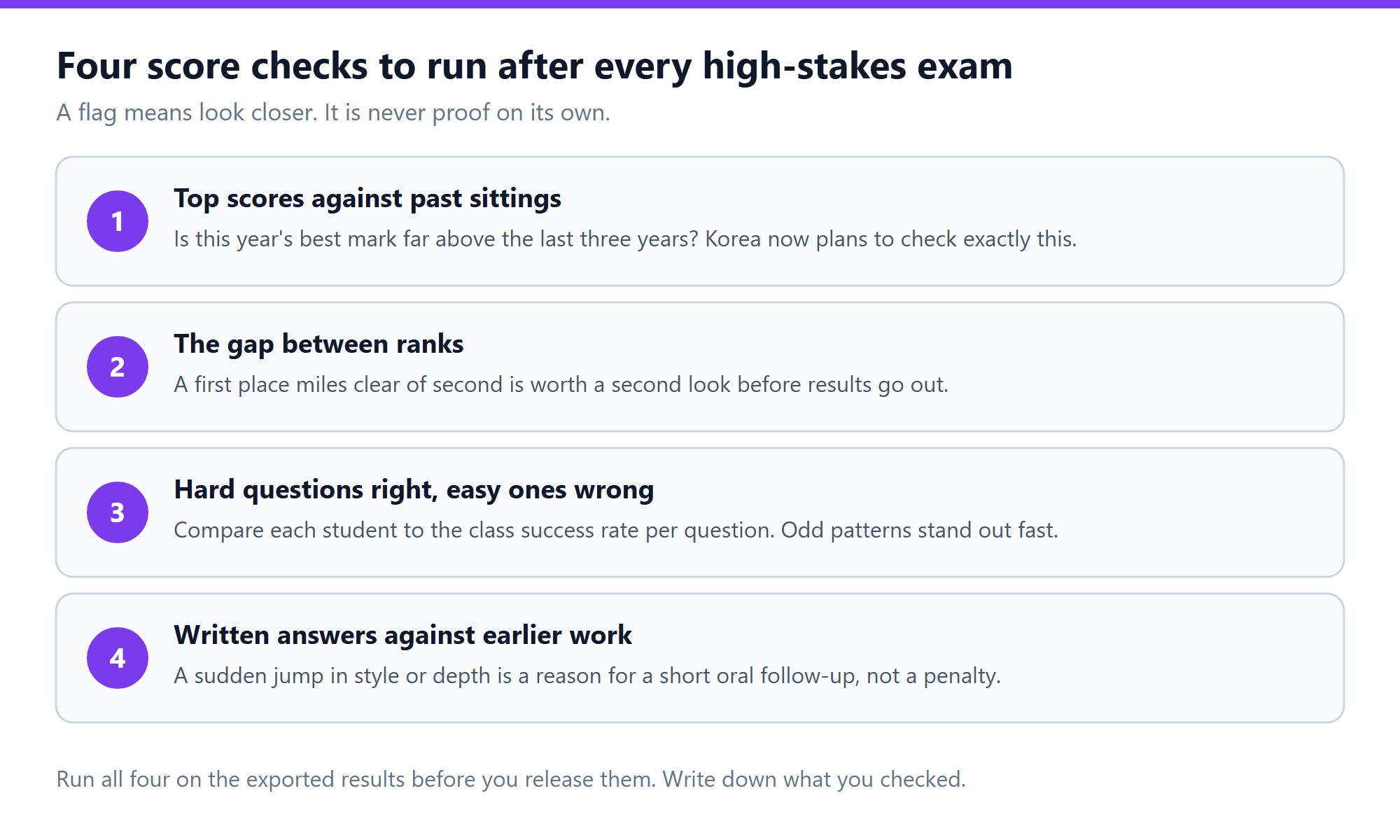
- Compare top scores with past sittings. Pull the best marks from the last three runs of the same exam. If this year’s top score sits far above that range, look at it before you publish. Korea now plans to do exactly this.
- Look at the gap between ranks. In most cohorts the top few scores sit fairly close together. A first place that’s miles clear of second is worth a closer look.
- Check per-question patterns. Work out the class success rate for each question, then compare each student against it. Someone who gets the three hardest questions right and misses easy ones stands out quickly. So does a group of students with the same unusual wrong answers.
- Compare written answers with earlier work. A sudden jump in depth, structure or vocabulary is a reason to ask a few questions about the answer in person. That conversation usually settles it either way.
Two rules keep these checks fair. First, a flag is a reason to look, not a finding. Some students really do have a great day, and treating a high score as guilt is exactly the “groundless suspicion” problem. Second, write down what you checked and why. We covered what an exam record needs to survive an appeal in September, and the same logic applies here.
Where ICT Exam fits
We should be clear about what ICT Exam does and doesn’t do. It isn’t a proctoring tool. It doesn’t watch cameras, detect devices or flag suspicious scores for you.
What it does give you is the data and the control to run the checks above. Per the ICT Exam features, every exam has a timer and an open and close window enforced on the server, a limit on attempts, and shuffled questions so students don’t see the same order. You see the whole class gradebook at a glance and can export results to CSV or JSON with per-question detail. Written answers are scored with AI support, but a teacher reviews and confirms every mark, and you choose what students see after they submit. That review step is where the checks above belong: export, look, then sign off.
If your exams carry real stakes, such as certificates, licences or admissions, build that review step into the timetable. A day between grading and release costs very little. A certificate revoked eight months later costs a lot more, for everyone.
Frequently asked questions
What happened in South Korea’s tax accountant exam?
The top scorer in the 2026 tax accountant exam admitted on 15 November 2026 that he used a miniature camera, a smartphone and a generative AI tool to get answers in both stages. Exam supervisors didn’t catch him. Police are investigating and officials are moving to cancel his pass.
What is Korea doing about AI cheating in qualification exams?
The labour ministry ordered a review of all 2026 national qualification exams. Planned measures include stricter smart device bans, radio-wave detection, supervisor training, checks for unusually high scores and rank gaps, and possibly publishing the top two scores in 37 professional exams. A full package is due by the end of 2026.
Can score data really detect cheating?
It can flag results that don’t fit the pattern, such as a top score far above past years or hard questions answered correctly while easy ones are missed. It can’t prove cheating on its own. Use a flag as a reason to review the work or talk to the student, never as the decision.
Does ICT Exam include proctoring?
No. ICT Exam doesn’t include camera proctoring or device detection. It provides server-enforced timers and windows, attempt limits, shuffled questions, teacher-confirmed grading, a setting for what students see after submitting, and CSV or JSON exports with per-question detail for your own review.
When should I run score checks?
Between grading and release. Export the results while the marks are still with the teacher for review, run the checks and record what you looked at. Then confirm the marks and release them.