South Korea will void a candidate’s college entrance exam if AI smart glasses are simply found in their bag, and ban them from next year’s exam if they wear them. The rules arrived after two universities caught glasses-wearing candidates in October and punished them very differently. For any smart online exam, the lesson is to write device rules down before test day.
The Korea Institute for Curriculum and Evaluation (KICE) published its test-taker guidelines for the 2027 College Scholastic Ability Test, the CSAT, on 15 October 2026. The exam itself is on Thursday 19 November. Smart glasses now sit on the list of banned items alongside smartwatches, and invigilators get guidance on spotting them for the first time.
What happened at Yonsei and the University of Seoul
Two incidents, a week apart, pushed this up the agenda.
- University of Seoul, 3 October. A candidate in a natural sciences essay exam was caught wearing smart glasses. They were removed from the room and barred from the university’s admissions exams for three years.
- Yonsei University, 10 October. Yonsei checked candidates’ glasses before its essay exam. One candidate wore ordinary glasses for the check, then swapped to smart glasses once the test began. That candidate was ordered to leave the exam.
Same device, same kind of exam, same month. One candidate lost three years of applications to that university, and the other lost one sitting. Neither university was wrong to act, but the gap shows what happens when the penalty is decided after the incident instead of before it.
The devices themselves are simple to describe. As the Korea Herald put it, smart glasses “can use cameras embedded in their frames to photograph exam questions, process them with AI and display answers or step-by-step solutions on screens built into the lenses.”
The three tiers in the CSAT rules
KICE’s guidelines turn that mess into a ladder anyone can read in advance.
- Possession. Bring smart glasses into the exam room and keep them in your bag without handing them in, and that exam is invalidated. You don’t have to use them.
- Wearing them. Fail to hand them in before the first session and wear them during the exam, and the exam is invalidated and you’re barred from the CSAT the following year.
- Refusing a check. Refuse an invigilator’s request to inspect your glasses, and after review it can be treated as serious cheating, on the same footing as wearing them.
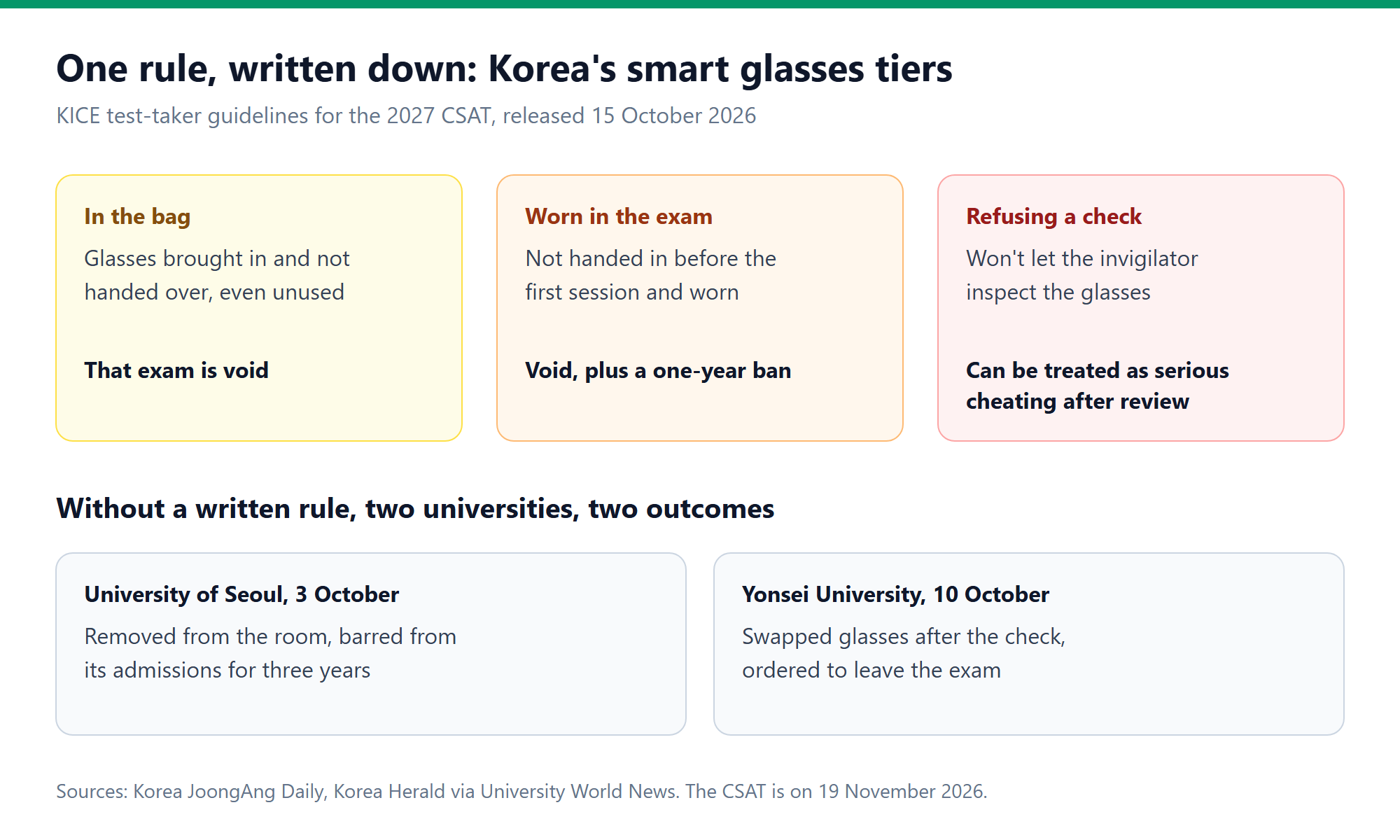
Notice what the ladder does. It separates having the device from using it, and it covers refusal so a candidate can’t dodge the question by declining to be checked. It’s published a month before the exam, so nobody can say they didn’t know.
Why this matters more for online exams
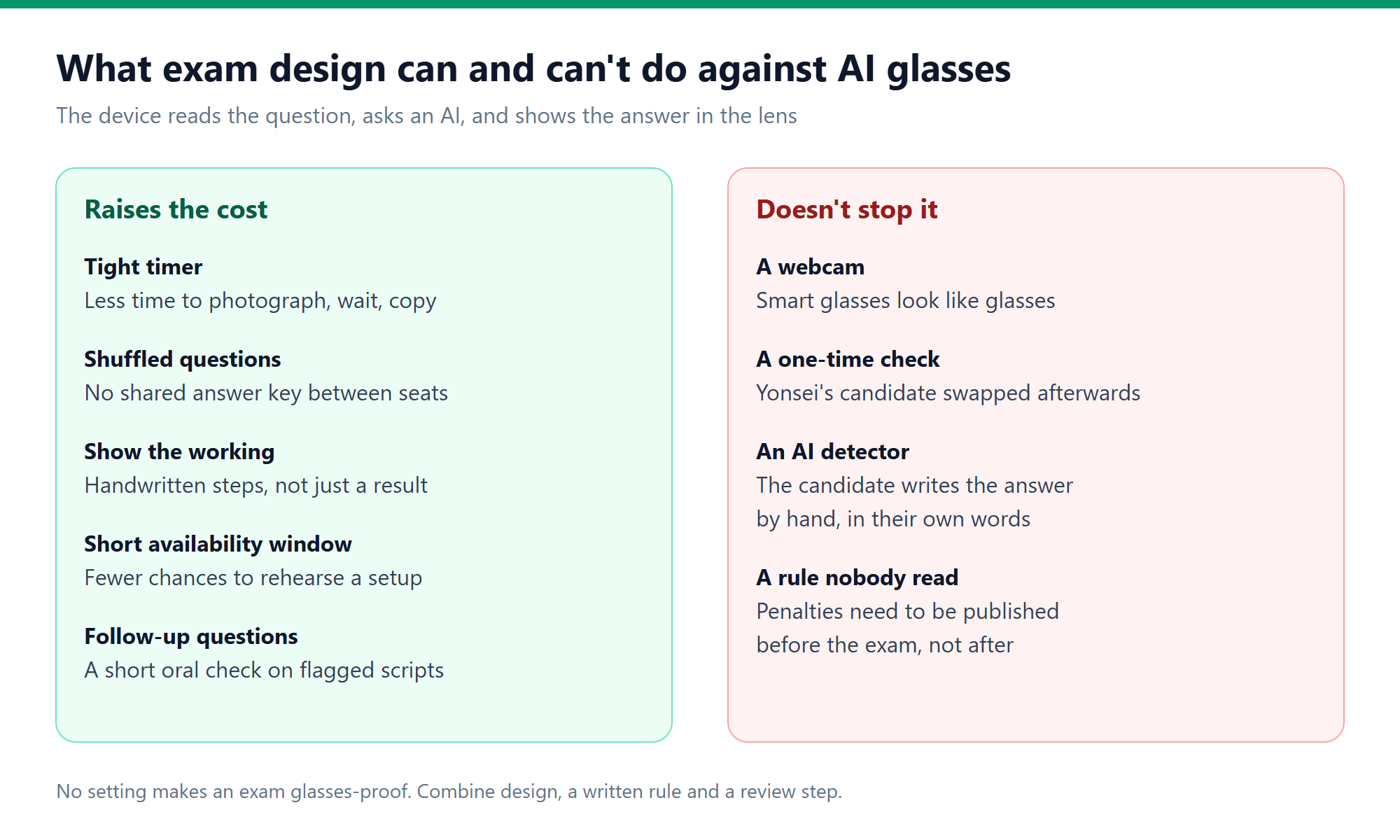
An exam hall has invigilators who can ask to see your glasses. A remote exam usually doesn’t. A webcam sees a student wearing glasses, and smart glasses are built to look like ordinary frames. There’s no reliable way to tell from a video feed.
AI detectors don’t help much here either. The candidate reads an answer in the lens and writes it themselves, by hand or in their own words, so there’s no pasted text to flag. We’ve written before about why detector scores don’t hold up as evidence on their own.
So the honest starting point is that no online exam setting makes a test glasses-proof. What you can do is make the device less useful, and make your rules clear enough that you can act fairly when you suspect it.
What exam design can and can’t do
Every tactic below raises the cost of using a device that photographs the question. None of them blocks it outright.
- A tight timer. Photographing a question, waiting for the AI and copying the answer all take time. A timer set to what a prepared student needs leaves little room for that loop.
- Shuffled questions. When every student sees a different order, a helper can’t share a single answer sequence.
- Ask for the working. A final number is easy to copy from a lens. Several lines of handwritten working, uploaded as an image, are slower to copy and easier for a teacher to question.
- A short availability window. An exam that’s open for an hour gives fewer chances to rehearse a setup than one open all week.
- Follow-up questions. A five-minute oral check on any script that looks off is still the strongest test of whether a student understands their own answer. We covered how to run those at scale in reviving oral exams online.
Write the device rule before the exam
The Korean ladder is a good template for any school, whatever platform it uses. Put a short device rule in your exam instructions, and make sure students see it before they start.
- Name the devices. Smart glasses, smartwatches, earbuds and second phones. Vague wording like “unauthorised aids” invites argument later.
- Split possession from use. Decide whether simply having a device nearby counts, and what the penalty is if it’s used.
- Cover refusal. If you ask a student to show their glasses to the camera or join a follow-up call, say what happens if they decline.
- Say what evidence you’ll rely on. A follow-up conversation, a comparison with earlier work, or the working the student uploaded. Not a hunch, and not a detector score alone.
- Apply it the same way every time. The point of a written ladder is that two students in the same situation get the same outcome.
If your coursework allows AI but your exams don’t, the rule matters even more, because students need to know exactly where the line moves. Our guide to running a no-AI exam tier covers how to set that up.
How ICT Exam fits
ICT Exam doesn’t do webcam proctoring, and we don’t claim it can catch smart glasses. What it gives you are the design controls above. You can set a timer and an open and close availability window, limit attempts, and shuffle questions so every student sees a different order. You can also choose what students see after they submit. Students can answer with an image or diagram, such as a photo of handwritten working. AI-assisted grading reviews it, and the teacher can always override the result. All of it is listed on the ICT Exam features page.
Pair those settings with a written device rule and a follow-up step for flagged scripts, and you’ve got something you can defend if a result is challenged.
Frequently asked questions
What happens if you bring AI glasses to the CSAT?
Under KICE’s 2027 guidelines, keeping smart glasses in your bag without handing them in invalidates that exam. Wearing them during the exam invalidates it and bars you from the CSAT the following year.
When is the 2027 CSAT?
The 2027 College Scholastic Ability Test is on Thursday 19 November 2026.
Can a webcam detect smart glasses in an online exam?
Not reliably. Smart glasses are designed to look like ordinary frames, and a video feed rarely shows the camera or the display in the lens.
What is the best defense against AI glasses in online exams?
No single setting stops them. A tight timer, shuffled questions, requiring shown working and short oral follow-ups all reduce their usefulness, and a written device rule lets you act consistently.
Does ICT Exam include proctoring?
No. ICT Exam provides exam controls such as timers, availability windows, attempt limits and question shuffling, plus AI-assisted grading with teacher review. It doesn’t monitor students by webcam.